Anna Schlüters view on „SELBSTPORTAIT MIT ADLERTATTOO“, Diptychon 2025 by Felix Giesen
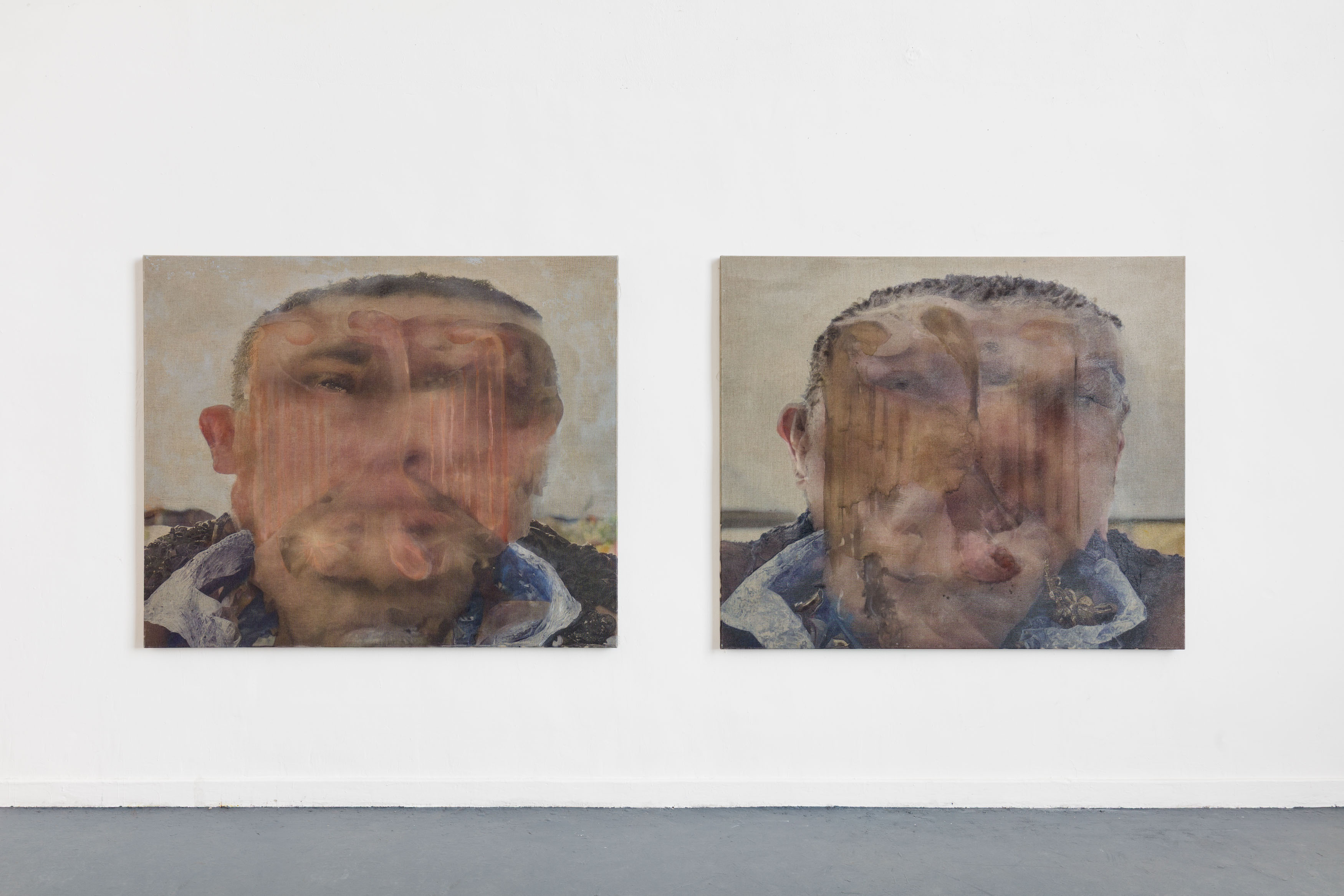
Two malformed male heads, each emerging from the same garment, are quickly perceived as two images of one and the same person. The heads appear colossal, their overall impression frighteningly massive. Through subtle overlays with the German federal eagle, both are depicted as entities in transition. While the visibility of the eagle in the first image still carries a latent, almost subliminal quality due to the flesh-pink tonality, it becomes more distinct in the second image through a brownish coloration. Painterly, the transformation manifests as a process of dissolution: clear contours are lost and the head widens in a disturbing manner. In both images, certain facial areas can only be vaguely discerned. They assume such indeterminate forms that associations arise far beyond human physiognomy. The eyes barely suggest a gaze, looking only into the indefinite. Only the ears on the right side, protruding like ornaments from the mass, may still be granted a sense of bodily normality.
Felix Giesen has fixed his own photographic likeness onto coarse linen using an alcoholic shellac solution and stretched it horizontally. After fixing the surface with rabbit-skin glue, the artist etched the eagle into it with the shellac solution and added accents with oil pigments. Thus, even through its production technique, the image oscillates between documentation and fiction. The artist translates the computer-assisted technique of “morphing” back into traditional painterly practice. The coarse weave of the linen supports this effect, disrupting print-like precision and allowing the painterly quality to assert itself more strongly.
Once Christianity came to dominate the Western world, the diptych primarily served as a devotional image. When folded, it was easy to transport and intended for private use while travelling; later it evolved into the secular double portrait. In the title, the artist reveals himself as the portrayed figure in two views, simultaneously alienating himself through painterly means and indicating this process in two phases. The individual recedes behind the eagle stencil, which, like a mask, offers both self-denial and protection. The indeterminacy of the portraits evokes forensic phantom images. Unflinching and courageous, the artist presents his own likeness in a visionary painterly confrontation, exploring the potential impact of far-right infiltration upon himself.
Felix Giesen has fixed his own photographic likeness onto coarse linen using an alcoholic shellac solution and stretched it horizontally. After fixing the surface with rabbit-skin glue, the artist etched the eagle into it with the shellac solution and added accents with oil pigments. Thus, even through its production technique, the image oscillates between documentation and fiction. The artist translates the computer-assisted technique of “morphing” back into traditional painterly practice. The coarse weave of the linen supports this effect, disrupting print-like precision and allowing the painterly quality to assert itself more strongly.
Once Christianity came to dominate the Western world, the diptych primarily served as a devotional image. When folded, it was easy to transport and intended for private use while travelling; later it evolved into the secular double portrait. In the title, the artist reveals himself as the portrayed figure in two views, simultaneously alienating himself through painterly means and indicating this process in two phases. The individual recedes behind the eagle stencil, which, like a mask, offers both self-denial and protection. The indeterminacy of the portraits evokes forensic phantom images. Unflinching and courageous, the artist presents his own likeness in a visionary painterly confrontation, exploring the potential impact of far-right infiltration upon himself.
„Melee“, Text by Nele Jackson
Testosterone levels in the Western world have been on a steady decline since the 1980s. Compared to your fatherat the same age, you have less grip strength, less sperm, and less friends. You wouldn‘t necessarily deduce a crisisof masculinity from looking at the average guy‘s Instagram feed: a wealth of resources on muscle building, combatsports, organ meat consumption, identifying „high value women“, and the like. On second thought though, it all makessense. Fear and obsession are often two sides of the same coin, like pedophile hunting and barely-legal porn. Asyour dick grows softer, you have to pretend harder. Pretending to have answers is young men‘s biggest imperativetoday. Amidst their uncertainty, unfulfilled longing, and hurt feelings, they seek out ideologies that project unwaveringcertainty: reactionism, conservatism, historicism. After all, nothing is more certain than the past. As a result, thepolitical gender gap widens like a fault line: while young women drift left, young men drift right. Both get lonelier, morestuck, more insane.
Yet some young men are pretending so hard you start to feel bad for them. The Düsseldorf fraternityRhenania Salinga displays its white-red-black banners with ceremonial pride. A recent addition to their home decoris a hand-painted flag reading „Frat Lives Matter“—as tone-deaf as it is behind schedule.Like most remaining „Burschenschaften“, Rhenania Salinga is an island of anachronism in a sea of ambiguity. A placewhere you can drink beer with your boys, blow off steam fencing, and „think critically“ about climate change. A refugefor lonely young men attempting to metabolize manhood through archaic ritual, seeking to understand the modernworld through the same discolored lens.
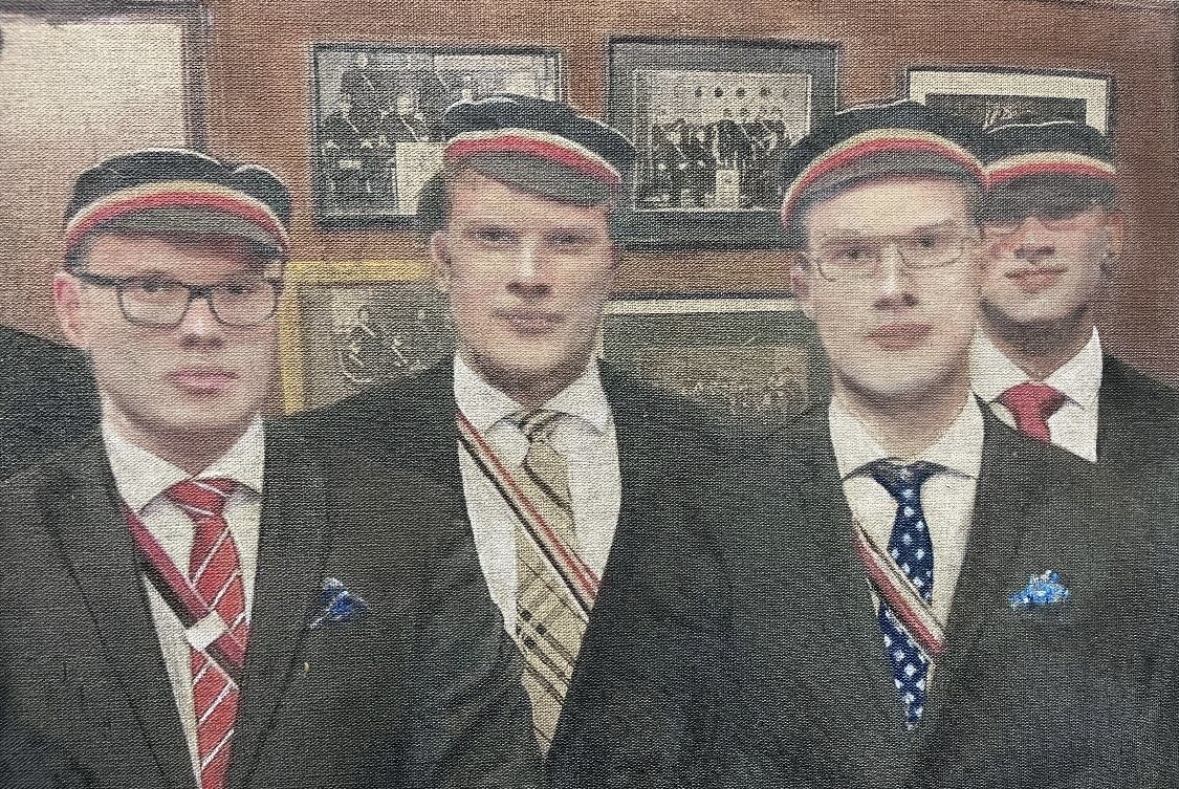
Artist Felix Giesen decides to engage with this subject through active infiltration rather than passive study. Usingdeepfake technology and self-trained AI models, Giesen has reimagined images from the archives of thesefraternities and transplanted his face onto those of the members. The exhibition‘s centerpiece presents thefrat brothers in their signature dark suits and caps, standing proudly with their pants around their ankles. Just a bunchof dicks, essentially, wearing the artist‘s face in varied expressions of pride and belonging. Giesen maps the strangemagnetism of backward-facing certainty, not from a distance but from within. By inhabiting these spaces and bodieshimself, he implicates himself in the questions he raises: What parts of masculinity are performance, and what partsare inescapable? Where is the line between distance and identification? And what shall we do about young men?
The technical process mirrors this conceptual tension. The digital manipulations are transferred to coarse brown linenthrough UV printing, creating a compromised translation from pixel to physical matter. The deliberately chosen brownfabric carries its own political weight—a dirty color signifying a corrosive fetish for tradition. Fraternities like RhenaniaSalinga offer young men coordinates to the chaos of their inner world: Stand here. Wear this. Drink thus. The tragedyisn‘t the existence of such institutions, but their direction—compasses calibrated to continents already submergedby time. The past is a different, high T country. The present is a lonely, confusing place, run and ruined by little nerdswho just want to make their daddy proud.
ABOUT THE ARTIST
Felix Giesen (b. 1999) emerged from the digital world, with a background in AI models, augmented reality, and virtualreality. Although his artistic journey began in digital art, where he explored technology‘s potential to create immersiveexperiences, his recent engagement with painting led him to discover a passion for translating the digital world intoanalog form. For this exhibition, Giesen created self-trained AI models fed with his own photographs that combinethemes of particular interest: dying German cultural phenomena, representations of masculinity within these cultures,and self-staged scenes.
Yet some young men are pretending so hard you start to feel bad for them. The Düsseldorf fraternityRhenania Salinga displays its white-red-black banners with ceremonial pride. A recent addition to their home decoris a hand-painted flag reading „Frat Lives Matter“—as tone-deaf as it is behind schedule.Like most remaining „Burschenschaften“, Rhenania Salinga is an island of anachronism in a sea of ambiguity. A placewhere you can drink beer with your boys, blow off steam fencing, and „think critically“ about climate change. A refugefor lonely young men attempting to metabolize manhood through archaic ritual, seeking to understand the modernworld through the same discolored lens.
Artist Felix Giesen decides to engage with this subject through active infiltration rather than passive study. Usingdeepfake technology and self-trained AI models, Giesen has reimagined images from the archives of thesefraternities and transplanted his face onto those of the members. The exhibition‘s centerpiece presents thefrat brothers in their signature dark suits and caps, standing proudly with their pants around their ankles. Just a bunchof dicks, essentially, wearing the artist‘s face in varied expressions of pride and belonging. Giesen maps the strangemagnetism of backward-facing certainty, not from a distance but from within. By inhabiting these spaces and bodieshimself, he implicates himself in the questions he raises: What parts of masculinity are performance, and what partsare inescapable? Where is the line between distance and identification? And what shall we do about young men?
The technical process mirrors this conceptual tension. The digital manipulations are transferred to coarse brown linenthrough UV printing, creating a compromised translation from pixel to physical matter. The deliberately chosen brownfabric carries its own political weight—a dirty color signifying a corrosive fetish for tradition. Fraternities like RhenaniaSalinga offer young men coordinates to the chaos of their inner world: Stand here. Wear this. Drink thus. The tragedyisn‘t the existence of such institutions, but their direction—compasses calibrated to continents already submergedby time. The past is a different, high T country. The present is a lonely, confusing place, run and ruined by little nerdswho just want to make their daddy proud.
ABOUT THE ARTIST
Felix Giesen (b. 1999) emerged from the digital world, with a background in AI models, augmented reality, and virtualreality. Although his artistic journey began in digital art, where he explored technology‘s potential to create immersiveexperiences, his recent engagement with painting led him to discover a passion for translating the digital world intoanalog form. For this exhibition, Giesen created self-trained AI models fed with his own photographs that combinethemes of particular interest: dying German cultural phenomena, representations of masculinity within these cultures,and self-staged scenes.